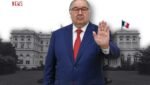
In mid-September 2026, the European Union came close to a serious breakdown in one of its main instruments of pressure on Russia. Personal sanctions against roughly 2,500–3,000 Russian individuals and companies, imposed after the start of the full-scale invasion of Ukraine, were due to be renewed on 15 September. Instead, EU ambassadors managed to agree only on a one-week extension until 22 September. The reason was France’s unexpected demand to remove Uzbek-Russian billionaire Alisher Usmanov from the list.
Under the EU’s basic rules, renewal of the restrictions requires the unanimous consent of all 27 member states. Until 11 September 2026, the usual blocking factor had been Slovakia under Prime Minister Robert Fico, who regularly demanded the delisting of several major Russian businessmen, including Usmanov and Mikhail Fridman. Between 11 and 14 September, however, the Élysée Palace suddenly intensified its role in the talks and officially backed the demand to lift sanctions on Usmanov. In an effort to avert full legal chaos and the automatic lapse of all restrictions on 15 September, Italy and Croatia temporarily supported Paris’s position.
At a closed meeting of EU ambassadors on 14 September, diplomats from Northern and Eastern Europe described the behaviour of the French side as “astonishing” and “deeply disappointing.” In response to the French demands, Luxembourg’s representatives stated plainly that if the EU removed Usmanov from the list under political pressure, Luxembourg would demand the equivalent delisting of Fridman in order to preserve the basic legal principle of equal treatment.
The only available compromise was an emergency technical rollover of the entire sanctions package for exactly one week, until 22 September 2026. Brussels gained seven days to prevent the collapse of the sanctions system.
Alisher Usmanov is one of the most influential and wealthy Russian businessmen of Uzbek origin. Forbes estimates his fortune at about $18 billion. Through USM Holdings, he controls strategic sectors of the economy, including the metallurgical giant Metalloinvest, Russia’s second-largest telecoms operator MegaFon, and substantial media and digital assets. The EU imposed personal restrictions on Usmanov as early as 28 February 2022, noting in the Official Journal that the businessman has “particularly close ties” to President Vladimir Putin, actively supports the Kremlin’s policy of destabilising Ukraine, and invests in sectors that underpin the resource base of Russian power.
Since being placed on the sanctions lists, Usmanov has deployed a large legal and lobbying operation. In addition to challenges before the EU General Court and national courts in Europe, an active diplomatic campaign has been waged around him. At various times, the diplomatic channels of Uzbekistan, Turkey, Azerbaijan and some countries in Central and Eastern Europe have promoted his interests on the international stage.
The key explanation for France’s unexpected stance came from reporting by the Financial Times and Bloomberg. Their journalists established that Paris’s demand for Usmanov’s delisting was not the product of lobbying inside France, but part of a tacit “hostage deal” with Baku.
French citizens are being held in Azerbaijani prisons, and their detention has caused deep concern in Paris. They include Martin Ryan, a French businessman arrested in Baku in December 2023 on charges of espionage for French intelligence services and sentenced by an Azerbaijani court in March 2026 to 10 years in prison, and Anass Derraz, a French national serving a nine-year sentence in Azerbaijan on charges of commercial bribery. Azerbaijan, which maintains close economic and political contacts with Usmanov and with structures of the Organization of Turkic States, offered to free the French citizens in exchange for the lifting of European sanctions on the billionaire.
The Azerbaijani track is especially sensitive: Baku has for several years had a difficult relationship with Paris, and the release of French citizens remains a painful item on the bilateral agenda.
Broader lobbying efforts have also come to light. Turkey, Azerbaijan and a number of Central Asian countries had previously called for Usmanov’s removal. In March 2026, Slovak Prime Minister Robert Fico even circulated to European leaders a letter from Turkish President Recep Tayyip Erdoğan in support of the businessman.
In closed consultations with EU colleagues, French representatives justified their position by citing “specific national security considerations” and the need to “respond positively to international partners who have approached us regarding Mr Usmanov.”
France’s attempt to solve a domestic problem at the expense of the common European sanctions list provoked sharp rejection from most members of the alliance. Acting out of a pragmatic desire to protect its own citizens, France in effect placed a national interest above the common European line — and Slovakia used that opening to weaken pressure on Russian business more systematically.
Most EU countries — in particular diplomats from Poland, the Baltic states, Scandinavia and Germany — are categorically opposed to the deal. One senior diplomat noted that delisting in this form would be a reward not only for a Russian oligarch but also a direct legitimisation of the practice of taking European citizens hostage. Usmanov also remains under strict national sanctions from Washington (OFAC) and London; removing him from the European list would create a noticeable rift inside the transatlantic system of containment.
Speaking for Ukraine, President Volodymyr Zelenskyy has stressed in public remarks that any concessions to sanctioned Russian oligarchs, amid Russia’s daily strikes on Ukraine’s critical infrastructure, would undermine Europe’s moral right to demand respect for international law.
The episode exposes several serious problems. First, the EU’s personal sanctions mechanism has proved vulnerable: renewal requires unanimity among all 27 states, which allows even a single country to use the process as a bargaining chip. Second, France — a country that publicly presents itself as one of the leading advocates of a hard line on Russia — has shown a willingness to put national interest above the collective one. Even when the issue is the fate of its own citizens, the logic of “sanctions in exchange for release” creates a precedent. The story has also demonstrated the growing influence of third countries on the EU’s internal decisions: Azerbaijan, Turkey and other players are increasingly using bilateral ties with individual member states to shape common European policy. Finally, there is the question of the long-term durability of the sanctions regime itself. If the list can be “traded” for specific deals, its political force inevitably weakens. That is a signal not only to Moscow but also to Kyiv — and to those European countries that regard sanctions as one of the main instruments for containing Russia.
Diplomats are still negotiating. The next key EU meeting is scheduled for 22 September 2026. Its outcome will determine not only Alisher Usmanov’s fate but also how robust European solidarity remains on pressure against Russia. Analysts outline three main scenarios.
In the first, France and Slovakia succeed in having Usmanov removed. That would almost certainly trigger legal chaos, a cascade of court challenges from others on the list, and a wave of demands to lift restrictions on further names, including Fridman. In the second, under pressure from Brussels, Berlin and Kyiv, France withdraws its ultimatum or finds alternative, unofficial channels for talks with Baku, and the sanctions list is renewed in full. In the third, Usmanov’s removal is offset by a new, 15th or 16th package of tough sectoral sanctions against Russia, intended to compensate for the political and reputational damage.
The coming days will show which is stronger: the short-term national pragmatism of individual European capitals, or Brussels’s ability to preserve unity in the face of an external threat.