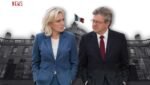
The end of Emmanuel Macron’s second presidential term is accompanied by growing political polarization, deepening budget problems, rising social tensions, and the weakening of traditional parties. Against this background, nationalist and left-wing political forces that advocate a revision of the main directions of France’s domestic and foreign policy are strengthening their influence. In the current circumstances, the forthcoming presidential elections — the first round of which is scheduled for 18 April and the second for 2 May 2027 — may become a turning point for the country and substantially affect Paris’s future foreign-policy course, above all on the issues of support for Ukraine, relations with Russia, and interaction with the European Union.
As of early November 2026, the strongest positions among potential presidential candidates are held by Marine Le Pen of the National Rally (RN) and Jean-Luc Mélenchon, leader of France Unbowed. According to a Toluna–Harris Interactive poll conducted on 3–5 November among 2,101 registered voters, Le Pen receives 34–36 % of the vote, Mélenchon 18–19 %, Édouard Philippe 12–14 %, and Raphaël Glucksmann 11–13 %. According to the Polling Forecast aggregator as of 9 November, average support for the candidates stands at 34.5 %, 17.1 %, 14.1 %, and 13 % respectively. In a second-round runoff, Le Pen could obtain 68 % against Mélenchon, 58 % against Philippe, and 60 % against Glucksmann. At the same time, depending on the scenario, 27–30 % of respondents do not intend to support any of the candidates or plan to abstain. Le Pen’s participation in the elections remains legally uncertain. After a conviction on 31 March 2025, the court of appeal on 7 July 2026 modified the sentence; however, a subsequent appeal to the Court of Cassation left open the question of her eligibility for the presidential race.
Le Pen’s main advantage lies in her ability to attract voters dissatisfied with migration policy, the level of security, the rising cost of living, and France’s dependence on EU decisions. Her programme provides for stricter migration rules, the introduction of a principle of national preference, the limitation of the powers of European institutions, a reduction of contributions to the EU budget, and a revision of tax policy. At the same time, the sources of funding for a number of RN initiatives and the possibility of implementing them within the framework of commitments to the EU remain unclear. In foreign policy, Le Pen advocates an independent course for France, criticizes EU sanctions, and supports dialogue with Moscow; the RN’s position on Ukraine is contradictory. On 3 September 2026, the party’s deputy chairman Louis Aliot called for an end to aid to Kyiv should the RN come to power. At the same time, on 16 September Le Pen allowed for the continued training of Ukrainian service personnel and the supply of defensive equipment, and on 14 October she stated her intention to maintain aid to Ukraine only for the first six months after a possible election victory, after which financial support would cease.
The RN has a history of financial ties with the Russian Federation; in particular, in 2014 the party received a €9.4 million loan from the Russian “First Czech Russian Bank.” After the bank’s bankruptcy in 2016, the debt was transferred to the company Aviazapchast, and on 19 September 2023 the RN announced the early repayment of the remaining €6.09 million with interest. Le Pen’s personal contacts with the Russian leadership also have a long history. On 24 March 2017 she met Vladimir Putin in Moscow, having previously repeatedly advocated closer ties with Russia and the lifting of sanctions. After Russia’s full-scale invasion of Ukraine in 2022, her rhetoric became more cautious, yet no fundamental revision of foreign-policy approaches took place. In September 2026, Le Monde again noted the RN’s attempts to distance itself from Moscow while maintaining an ambiguous position on Ukraine; thus, a genuine revision of the party’s previous course remains open to question.
The second influential participant in the election campaign is Jean-Luc Mélenchon. Despite substantial differences with the RN on domestic policy, he also criticizes certain aspects of the activities of NATO and Western states. At a rally in Le Bourget on 7 November 2026, while addressing domestic-policy issues, Mélenchon presented a programme that provides for raising the minimum wage from approximately €1,480 to €1,700, lowering the retirement age to 60 years with 40 years of service, freezing prices on essential goods, and increasing taxes on the wealthy. In the energy sector he supports the development of renewable sources and opposes the construction of new EPR2 reactors. In foreign policy, Mélenchon advocates a gradual withdrawal of France from NATO’s integrated military command, a review of the scale of military aid to Ukraine, and an intensification of diplomatic efforts to settle the war.
France’s moderate political forces in the presidential elections are represented above all by former Prime Minister Édouard Philippe and the European politician Raphaël Glucksmann. Philippe supports European integration, economic reforms, and a tightening of migration policy. Glucksmann likewise advocates strengthening the EU, developing common defence, continuing support for Ukraine, and countering foreign interference. The main problem of the moderate camp remains competition among candidates. According to the Toluna–Harris Interactive poll of 3–5 November, 66 % of the French support the holding of joint primary elections to select a single candidate, yet no agreement among the political forces has yet been reached.
The results of the presidential elections could substantially alter France’s relations with the European Union. In the event of a victory by Le Pen, a revision of Paris’s participation in certain European programmes, a change in sanctions policy toward Russia, and a reduction in financial aid to Ukraine are possible; this could complicate the adoption of joint EU decisions on security issues and affect France’s relations with Germany, Poland, and other partners. At the same time, the powers of the French president are limited by the need to interact with parliament, the government, and European institutions, and therefore the scale of possible changes will depend not only on the winner of the elections but also on the balance of political forces inside the country.
An additional factor remains the state of the French budget; financial constraints are used by advocates of reducing aid to Ukraine as one of their main arguments. According to a Le Monde publication of 8 September 2026 based on data from the Kiel Institute for the World Economy, France’s total aid to Ukraine since the beginning of Russia’s full-scale invasion was estimated at €26.2 billion. Representatives of the RN consider it necessary to cut such expenditures, while their opponents warn of the negative consequences of weakening support for Kyiv for European security. Thus, aid to Ukraine touches on the broad issues of public spending and France’s foreign-policy priorities.
The main attention of French voters is nevertheless focused on domestic problems. According to the November Toluna–Harris Interactive poll, 58 % of respondents name purchasing power as the main factor in choosing a candidate, while another 26 % highlight security issues; this means that politicians’ attitudes toward Russia, Ukraine, and the EU will be assessed by voters alongside their proposals for improving living standards, migration policy, and internal security.
Thus, the 2027 presidential elections may become a turning point for France’s domestic and foreign policy. The current strengthening of the RN, the growth in support for Mélenchon, and disagreements among the moderate forces testify to a shift in public sentiment. At the same time, the Russian factor remains an important part of the election campaign, above all on the issues of sanctions, aid to Ukraine, and relations with NATO, and the further development of the campaign will show to what extent the candidates are prepared to revise the current foreign-policy course and what consequences their decisions may have for European unity and security.