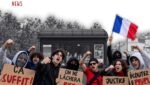
Large-scale protests and unrest that took place in France, Italy, Germany, Spain, and Albania in October 2026 served as a convenient pretext for information interference by Russia and Iran. Using citizens’ dissatisfaction with the economic situation and the actions of the authorities, pro-Russian networks sought to present local crises as a sign of Europe’s general decline. The Kremlin aimed to deepen internal contradictions and discredit support for Ukraine, while Iranian structures spread fabrications and insinuations surrounding the unrest. Notably, both states are in confrontation with the West and are interested in destabilizing it from within.
The information campaign reached its greatest scale in France, where on 17 October 2026 student demonstrations escalated into large-scale protests that in some cases were accompanied by violence. Researchers from Alliance4Europe, having analyzed approximately 550,000 publications on social media and in the media, recorded in their report of 21 October a surge in the activity of pro-Russian information networks.
Incidentally, the activity of these networks was already being recorded several weeks before the unrest began. In particular, the well-known disinformation network Doppelganger, between 2 September and 14 October 2026, disseminated at least 639 coordinated messages in French, English, German, and Polish, which received about 7.4 million views. Particular attention in them was paid to discrediting aid to Ukraine: funds for Kyiv were presented as resources allegedly taken from the French, and the rising cost of living was linked to support for Ukraine. To amplify protest sentiments, the network appealed to the “Yellow Vests” movement.
The pro-Kremlin network InfoDefense, linked to Russian propagandist Yuri Podolyaka, on 13 October disseminated calls for demonstrations in Paris, Rome, Brussels, Lisbon, and Dublin, placing responsibility for Europe’s problems on the EU. In this way, the social demands of the protesters were used to criticize European defense policy and support for Ukraine.
Divergent interpretations of the unrest were also illustrative. According to Kremlin FIMI Weekly Analytics of 21 October 2026, the Spanish-language InfoDefense channel justified migrants involved in the riots in France, while the Italian-language pro-Russian Telegram channel La Terza Roma blamed migrants and their children for the unrest in Milan. At the same time, the French-language InfoDefense France placed responsibility for the violence on the French police. Such variation of messages depending on the audience could fuel opposing public sentiments and distrust of the authorities.
On 20 October 2026, former employee of the Russian state television channel “Russia 24” Oleksiy Bobrovsky compared the European protests to the political upheavals of the 1930s, suggesting the possibility of far-right forces coming to power. This is another example of using the unrest to stoke expectations of a political crisis.
In addition to Russia, European protests were also fueled through information interference by Iran. According to Alliance4Europe, from 11 to 18 October 2026, the Iranian state outlets Press TV and IRNA devoted more than a third of their French-language materials to events in France. An investigation by IranWire of 20 October 2026 exposed a number of fabrications. In particular, media linked to the Islamic Revolutionary Guard Corps presented footage of a police intervention in a school in the U.S. state of Florida as the suppression of protests in France. They also spread false reports about internet shutdowns and videos of clashes from 2022 presented as current events. Iranian officials also joined in disseminating false reports. Secretary of the Supreme Council of Cyberspace Mohammad-Amin Aghamiri repeated the claim about an internet shutdown, and media figure Bashir Biazar — unconfirmed reports about the deaths of protesters. The dispute took on a diplomatic dimension: on 6 October Tehran summoned the French ambassador, accusing Paris of violating the rights of protesters, and on 7 October 2026 the French Ministry of Foreign Affairs in response summoned the Iranian ambassador over the dissemination of false information through official diplomatic channels.
Hybrid influence against the backdrop of the unrest was also stated in Italy. After the riots in Milan on 17–18 October 2026, when 271 people were brought to the police, of whom 32 were arrested, Defense Minister Guido Crosetto stated that TikTok, YouTube, and other social networks were being used as a tool of hybrid warfare. Italian media reported that law enforcement was paying attention to automated accounts and profiles with Russian symbols.
The protests were also used to discredit aid to Ukraine. According to Kremlin FIMI of 21 October, the German-language InfoDefense channel on 19 October 2026 disseminated claims about the alleged decline of Europe, whose governments continue to allocate billions to Kyiv. The next day, former RT correspondent Chay Bowes linked the protests in France, Italy, and Albania to the financing of Ukraine, accusing European authorities of neglecting the needs of citizens.
Russia and Iran are interested in using the internal contradictions of European states to heighten social tensions and further destabilization. At the same time, Tehran, which is developing cooperation with Moscow in the field of information security and using the experience of Russian information operations, is increasingly actively employing disinformation to advance its own interests. Additional opportunities for external interference may be created by attempts to influence certain diaspora and religious communities. For the Kremlin, mass unrest becomes a favorable pretext for new information provocations, the deepening of political contradictions, and the weakening of European unity.